

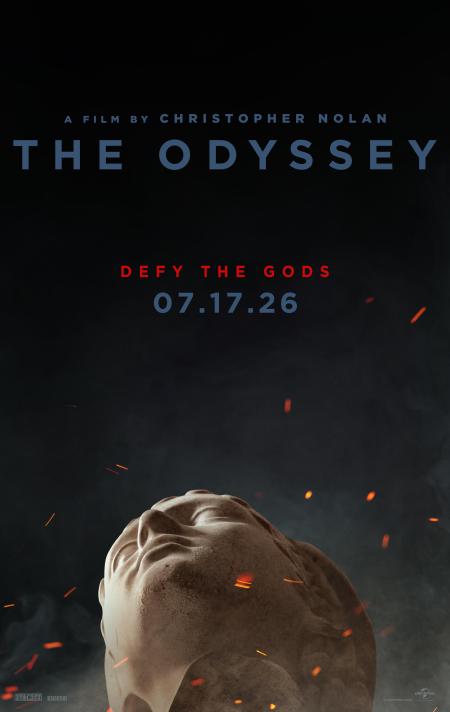
Rating of
3.5/4
In Nolan we trust
Matthew Brady - wrote on 11/08/26
"The most we want is what the most we can't have, and what the most we can't have is what we already had...and lost."
Christopher Nolan, you son of a bitch, you did it again. You clever, magnificent bastard. Nolan is the only director who can motivate me to wake up early, travel to the cinema, and catch the first showing on opening day. I was eager to see the movie as soon as possible and couldn't wait to see it. I’m so happy my expectations were not only met but exceeded.
The Odyssey is a behemoth of a film that’s both cinematically ambitious and beautifully cohesive—one of the best cinematic experiences I’ve had in ages. I’ve never felt more locked into a movie on this scale. Despite the three-hour runtime, I was never bored. My eyes were glued to the screen. This probably has the best third act of any of Chris Nolan's movies. Chills after chills after chills. So satisfying, so freaking good.
Even days later, I still can’t stop thinking about it. I keep returning to the themes and ideas it raises: the visuals, the score, the performances—everything.
Is the film perfect? No, and I don’t care. Is it accurate? No, and neither is the original. It’s a fantasy featuring Cyclops, witches, and gods. Complaining about accuracy is pointless.
I’ve seen the movie twice now, both times in IMAX (as Nolan intended). On my first watch, I loved it, but I didn’t appreciate everything right away. Since I never read the book it’s based on, I spent the entire time trying to familiarize myself with every character, their relationships, the story, and the many ideas the movie explores. On the second go-around, with everything more familiar, I had a much richer experience. I felt more emotionally attached to the characters and the story, and by the end I had a fresh experience. Nolan's films encourage multiple viewings, revealing new details each time and making each experience feel fresh.
Christopher Nolan's direction is outstanding; he always leaves you wondering, 'How did he do that?' about the behind-the-scenes techniques he uses. Hoyte van Hoytema's breathtaking cinematography vividly brings Nolan's expansive vision to life. We also see him venture into horror with three memorable scenes (the Cyclops, Circe, and Hades) that are genuinely tense and terrifying. At this stage, we want him to make a horror film someday, as he has the chops for it.
Nolan is known for his realistic approach to the film's setting. The production was shot on location, with scenes filmed on real ships in open water and practical effects used to create a believable, lived-in fantastical world. In the scene where the characters encounter a cyclops in the cave, their first response isn’t surprise but cautious recognition, as if they’re familiar with such creatures in this world, like an accidental encounter with a grizzly bear in the woods.
The cast is SACKED, and everyone was terrific. Standouts include Matt Damon, Anne Hathaway, Himesh Patel, Robert Pattinson, Samantha Morton, and John Leguizamo.
Matt Damon delivers an outstanding performance as Odysseus, possibly his best. The character is portrayed as a figure who, according to those who knew him before his 20-year absence, is a legend. In truth, he is a wounded soldier haunted by his own mistakes, which weigh heavily on his mind and spirit. War transforms a person in profound ways. The film follows his journey to return to his wife and son, though part of him resists, unsure whether he is still the same or whether there is a home to return to. In one scene, the Song of the Siren showcases Damon’s raw, emotional performance and his haunting screams of pain, which brought me to tears and reveal much about the character.
Anne Hathaway is excellent as Penelope, Odysseus's wife, who tries to keep everything in order even as it crumbles under Odysseus's 20-year absence. Yet no one recognizes her as a leader, consistently undermining her efforts. They even dare to claim the throne has been vacant for years, even though she sits on it. Hathaway delivers a powerful monologue in the third act that makes you feel and understand her frustration, sadness, and the burden of everything falling on her shoulders.
Both Damon and Hathaway are truly talented actors who often don’t receive the recognition they deserve, despite being Oscar winners and Hollywood stars. I still believe they are underrated and deserve greater appreciation. They also deserve Oscar nominations for this film.
Robert Pattinson is great as Antinous, a sniveling, snake-in-the-grass character. Pattinson delivers a couple of hilarious lines. I also love his microexpressions in a couple of scenes, which are so subtle and awesome.
Himesh Patel is stellar as Eurylochus, a prominent member of Odysseus's crew. He strikes the right balance between being a voice of reason and remaining loyal to his king, while also casting some doubt. It illustrates how much he's willing to sacrifice for his king and the extent of those sacrifices. His reactions in nearly every scene are remarkable.
John Leguizamo excels as Eumaeus, the complex blind man, blending humor and sadness in a society on the brink of collapse—a captivating performance. Despite their limited screen time, Samantha Morton, Elliot Page, and Lupita Nyong'o deliver powerful performances, with Morton's portrayal of Circe standing out. Her scene is genuinely nightmare-inducing and unexpected for a Nolan film. And don't let those idiots on the internet tell you otherwise; Page and Nyong'o are both solid.
Tom Holland delivers a solid performance as Telemachus. His strongest moments come when he relies on reactions rather than words, highlighting his character’s depth. Some overlook the thoughtful choices he makes and how he presents them, such as appearing tough on the outside while feeling vulnerable inside during his search for his father, or hiding his joy to stay composed. It’s all conveyed through his eyes. His performance deserves greater recognition.
Special acknowledgment to this talented bunch who also did terrific work: Zendaya, Benny Safdie, Jon Bernthal, Bill Irwin, James Remar, Corey Hawkins, Ryan Hurst, and Charlize Theron.
Another banger of a score by Ludwig Göransson. One of the things I love about him is that he always takes an interesting approach, perfectly in tune with a film's themes and visuals. Whenever a scene evokes horror, he makes the score feel otherworldly, with an uneasy undercurrent of violent anger and despair. In other scenes, he evokes Vangelis's scores, with that iconic synth sound, like an '80s fantasy film. Or, to evoke beauty, sadness, or longing, he makes you feel deeply moved and captivated.
Nolan transforms the poem into a story that feels shockingly urgent and relevant in today’s world. It's not just a modern update that simplifies things for viewers, but a thoughtfully crafted adaptation that reflects current events. The cycle remains unchanged. I’ll keep some details vague so you can experience the story firsthand—even though I know it's an old story and some people already know it. But what Nolan does with it is best discovered on your own. The most memorable adaptations are those in which creators wholeheartedly embrace a reinterpretation that truly speaks to their own time.
Zeus’s Law is referenced multiple times throughout the film. It is an ancient Greek rule that encourages respect, shelter, and generosity toward strangers, who might be gods in disguise testing our compassion. The film invokes this law to prompt modern viewers to reflect on our era and the decline in humility we’ve witnessed locally and globally. Today, it's important to practice more kindness and respect—not because strangers might be gods, but out of genuine compassion. Be kind.

